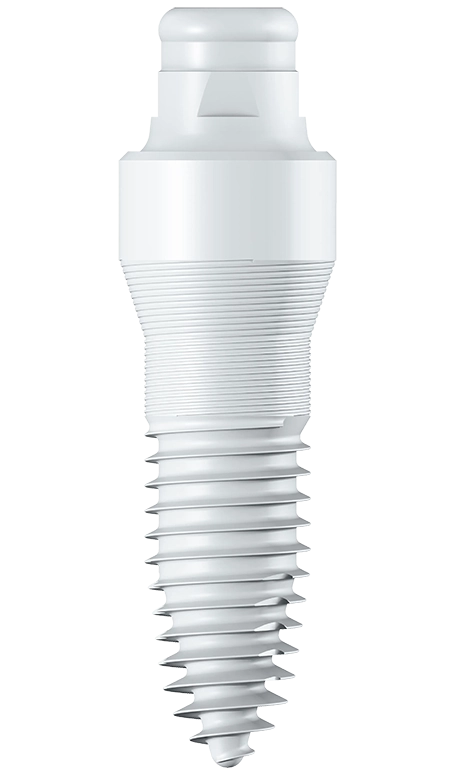
Ceramic implants made from zirconia are the gold standard for patients who want to replace missing teeth without any metal in their body. While titanium implants have been the clinical standard for decades, an increasing number of patients are now consciously choosing ceramic implants because they are completely metal-free, highly biocompatible, and aesthetically superior to any metal-based alternative. At our dental practice in Freienstein, we exclusively use metal-free implants — a core element of our metal-free dentistry philosophy.
Zirconia is a high-performance ceramic material that has been successfully used in medicine for decades — for example, in orthopaedic hip replacements. In dentistry, zirconia has established itself as the ideal implant material because it matches the structural strength of titanium while being significantly more biologically compatible with human tissue.
Ceramic implants made from zirconia offer a range of benefits that make them particularly attractive for health-conscious patients. A decisive advantage is complete metal-freedom. Unlike titanium, zirconia does not release metal ions that can migrate into surrounding tissue or the bloodstream. This is especially relevant for people with metal sensitivities or allergies.
Another key advantage concerns aesthetics. Ceramic implants are white and do not cause the greyish shimmer through the gums that can occur with titanium implants, particularly in the front-teeth area. The result is a natural, harmonious appearance that is virtually indistinguishable from real teeth.
Furthermore, zirconia shows lower plaque accumulation than titanium. Studies confirm that bacteria adhere less easily to the smooth ceramic surface, significantly reducing the risk of peri-implantitis — inflammation of the tissue surrounding the implant. The gums heal faster and remain healthier in the long term.
Finally, electromagnetic neutrality plays a role. Ceramics are non-conductive and do not generate galvanic currents in the mouth, as can occur with different metals in the oral cavity. In biological dentistry, this is considered an important factor for overall systemic wellbeing.
Ceramic implants are suitable for most patients who have lost one or more teeth. They are particularly recommended for people who value metal-free restorations, suffer from metal allergies or sensitivities, desire optimal aesthetics in visible areas, or prefer a holistic and biological approach to their dental care.
A prerequisite for successful implantation is sufficient bone volume. At our practice, we use state-of-the-art 3D diagnostics (CBCT/DVT) to precisely measure the jaw and plan the implantation with maximum accuracy. Should bone volume be insufficient, we offer various bone augmentation procedures using biological materials to prepare the site appropriately.
Treatment with a ceramic implant follows a structured, safety-first process. It begins with a comprehensive consultation and diagnostic phase: we discuss your goals, analyse the jaw with 3D imaging, and create an individual treatment plan tailored to your anatomy.
The implantation itself is performed under local anaesthesia or, upon request, under general anaesthesia. Dr. Siouri places the ceramic implant into the jawbone using a minimally invasive technique. Depending on the clinical situation, the implant can be restored with a crown immediately or after a healing phase of three to six months. We offer both immediate and delayed ceramic implant options, which Dr. Siouri will discuss with you based on your individual case. During the healing period, the zirconia implant fuses firmly with the bone — a biological process known as osseointegration.
Finally, a custom-made all-ceramic crown is placed on the implant, precisely matched to your natural teeth in shape, colour, and translucency. The result is a tooth replacement that meets the highest functional and aesthetic standards.
At our practice in Freienstein, ceramic implants are embedded within a comprehensive biological treatment concept. This means we exclusively use biocompatible, metal-free materials; support the body’s natural healing response with PRF (platelet-rich fibrin) therapy and ozone therapy; apply gentle, minimally invasive surgical techniques; and consider the systemic interactions between oral health and whole-body health.
Dr. Jousef Siouri holds multiple master’s degrees and a PhD (RWTH Aachen) in the field of implantology and has specialised in metal-free restorations. Patients from across the German-speaking world seek out our practice specifically for biological implantology — a testament to the consistent quality of outcomes we achieve.
How long do ceramic implants last?
With proper care and regular check-ups, ceramic implants made from zirconia can last a lifetime. Long-term studies show success rates of over 95 per cent after ten years — comparable to titanium implants. Consistent oral hygiene and professional prophylaxis appointments are the key factors in preserving implant longevity.
Are ceramic implants more expensive than titanium implants?
Ceramic implants are somewhat more expensive than titanium initially. However, considering the long-term health benefits, absence of metal ion release, and superior aesthetics — especially in visible zones — the overall value is excellent. We are happy to advise you individually on costs and provide a transparent written estimate.
Does health insurance cover ceramic implants in Switzerland?
In Switzerland, dental implants are generally not covered by basic health insurance (Grundversicherung). Depending on your supplementary insurance (Zusatzversicherung), partial costs may be reimbursed. We are happy to provide a detailed cost estimate that you can submit directly to your insurer for clarification.
Is the ceramic implant procedure painful?
The procedure is performed under local anaesthesia, so you will not feel any pain during the treatment. For patients with dental anxiety, we also offer treatment under general anaesthesia upon request, ensuring a completely stress-free experience. After the procedure, mild swelling may occur, which typically subsides within a few days. Our team will provide full post-operative guidance to support a smooth recovery.